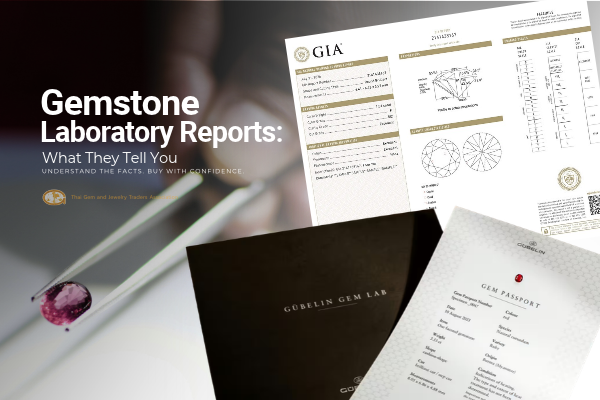
When purchasing a ruby, a buyer may receive a laboratory report from a well-known international gemological institution stating that the stone is natural, has undergone heat treatment, and originates from a particular country. But does this information mean the gemstone is of high quality or worth the price quoted by the seller?
The answer is no—not necessarily.
A gemstone laboratory report provides scientific information about a gemstone’s identity and characteristics, but it does not automatically establish its market value or selling price. Even when issued by a highly respected laboratory, a report must be understood within the scope of the services and findings it covers.
Understanding what a report can—and cannot—tell you is essential for consumers seeking confidence in their purchases and professionals who rely on gemological evidence in commercial transactions.
A gemstone laboratory report is a document issued by a gemological laboratory that records the results of examinations and analyses performed on a gemstone. The information provided depends on the type of report, the laboratory’s procedures, and the scope of the service requested.
Internationally recognized institutions that offer gemstone testing services include:
Gemological Institute of America (GIA): Provides laboratory services for diamonds and colored gemstones, including gemstone identification and the detection of indications of treatments.
Swiss Gemmological Institute SSEF: A Swiss institution specializing in the scientific examination of gemstones, diamonds, and pearls, with particular expertise in high-quality colored stones.
Gübelin Gem Lab: A long-established gemological laboratory known for colored gemstone analysis, treatment detection, and geographic origin determination.
American Gemological Laboratories (AGL): A US laboratory specializing in colored gemstone analysis, treatment reporting, and geographic origin opinions.
Each institution offers different services and reporting formats. Buyers should therefore check exactly what a particular report covers before using it to support a purchase or sale.
Sources: GIA, SSEF, Gübelin Gem Lab, AGL
One of the most important functions of a gemological laboratory is to identify the material submitted for examination. This may include determining whether a stone is a ruby, sapphire, emerald, spinel, or another material, and whether it is natural, laboratory-grown, or a different type of material, based on the laboratory’s findings.
This distinction matters because materials with similar appearances may differ significantly in their composition, formation, and commercial value.
For example, natural and synthetic rubies can have very similar appearances and may not be reliably distinguished by visual inspection alone. Scientific gemological testing can help establish the identity of the material.
Buyers should always refer to the actual wording of the report rather than relying solely on a seller’s description or trade name.
Many gemstones undergo treatments to improve or alter their appearance. Depending on the gemstone, these may include heat treatment, fracture filling, dyeing, or other enhancement processes.
Laboratories can report indications of treatments detected through their examination methods. For example, a sapphire report may identify evidence of heat treatment or fracture filling, with additional details where the laboratory’s reporting system provides them.
This information is important because treatment status can influence a gemstone’s appearance, durability, market demand, and value.
However, the absence of detected evidence of treatment does not necessarily prove that every possible treatment can be ruled out. Findings depend on the methods used, the available technology, the characteristics of the stone, and the laboratory’s reporting criteria.
Sources: GIA – Colored Stone Reports, SSEF – Sapphire Reports, SSEF – Emerald Reports
For certain colored gemstones, including ruby, sapphire, and emerald, geographic origin can be an important consideration in the trade.
Specialized laboratories may examine a gemstone’s inclusions, trace-element composition, and spectroscopic characteristics, comparing the results with reference data from known sources. Based on this evidence, a laboratory may issue an opinion on the stone’s geographic origin.
However, geographic origin determination is a scientific opinion based on available evidence, not an absolute guarantee in every case. Gemstones from different locations can share similar characteristics, making their origins difficult to distinguish. In some cases, a laboratory may be unable to reach a conclusive determination.
Geographic origin must also be distinguished from supply-chain provenance. A report identifying a gemstone as originating from a particular country does not automatically establish which mine produced it, who owned it, or every transaction through which it passed before reaching the buyer.
Sources: GIA – Identification and Origin Reports, SSEF – Sapphire Reports, AGL – Origin Determinations
Depending on the report type, a laboratory report may include:
Carat weight
Measurements and dimensions
Shape and cutting style
Color description
Photographs of the examined gemstone
Other details relevant to the specific service
These details provide a common reference for buyers and sellers and can help establish whether a gemstone corresponds to the information recorded in its report.
However, the terminology used to describe color, cutting style, and other characteristics may differ among laboratories and report types. Reports should therefore be interpreted according to their own criteria rather than compared without considering these differences.
One common misconception is that a report from a respected laboratory confirms that a gemstone is worth the price quoted by the seller.
In reality, GIA explicitly states that it does not appraise gemstones or determine their monetary value. Its reports provide information about a gemstone’s characteristics, while valuation requires consideration of additional factors.
For colored gemstones, market value may be influenced by:
Hue, tone, saturation, and color consistency
Clarity, transparency, and internal characteristics
Cutting quality and proportions
Carat weight and rarity
Treatments and geographic origin
Market demand, timing, and the sales channel
Consequently, two natural rubies of the same weight and geographic origin may have substantially different market values.
A laboratory report is evidence that supports valuation; it is not a guarantee of a particular selling price.
Sources: GIA – Does GIA Certify or Appraise Diamonds and Other Gemstones?, Jewelers of America – Diamond Grading Reports
Identifying a gemstone as natural does not mean that it is necessarily beautiful, rare, or superior in quality to other stones.
A report may identify a gemstone as a natural ruby, but its visual appeal and market desirability still depend on factors such as color, clarity, transparency, cutting quality, and overall appearance.
Furthermore, recording a gemstone’s color and characteristics is not necessarily equivalent to assigning it an overall quality grade. GIA’s colored gemstone reports describe and identify gemstone characteristics but do not grade sapphires or other colored gemstones in the same manner as its diamond grading system.
Buyers should check whether a document is an identification report, an origin report, or a specialized analytical report before drawing conclusions about quality.
Source: GIA – Does GIA Grade Sapphire or Other Colored Stones?
Geographic origin and commercial provenance are two different things.
A laboratory may provide an opinion about where a gemstone formed geologically. That finding does not independently establish the mine from which the stone was extracted, the identity of every trader involved, or whether its commercial history is fully documented.
Buyers who require supply-chain traceability should also examine supporting documentation, such as invoices, supplier records, and other evidence linking the gemstone to its claimed source and successive transactions.
A laboratory report reflects the gemstone as examined at the time of testing. If the stone is subsequently recut, treated, fracture-filled, or otherwise altered, the original report may no longer accurately represent its current condition.
This is particularly relevant to gemstones such as emeralds, whose fractures may be filled with foreign substances to improve apparent clarity.
In June 2026, SSEF issued a trade alert concerning the fraudulent filling of fissures in emeralds after laboratory testing. The alert highlights the importance of verifying reports and considering a new examination when there is reason to suspect that a gemstone has been altered after testing.
This case illustrates an important principle: a report that accurately described a gemstone when issued may not be sufficient if the stone’s condition has subsequently changed.
Source: SSEF – Trade Alert: Fraudulent Filling of Fissures in Emeralds After Laboratory Testing
Choosing a laboratory involves more than selecting a familiar name. Buyers should consider the gemstone type, the purpose of testing, and the specific information required.
| Laboratory | Relevant areas of service |
|---|---|
| GIA | Colored gemstone identification, treatment detection, and geographic origin reports for eligible gemstones |
| SSEF | Scientific analysis of colored gemstones, treatment detection, and geographic origin opinions |
| Gübelin Gem Lab | Advanced gemological analysis, treatment detection, and origin-related services |
| AGL | Colored gemstone identification, treatment reporting, and geographic origin opinions |
These descriptions are general overviews, not a ranking of laboratory quality. Available services, terminology, and report details vary by gemstone and service category.
No single report type is suitable for every gemstone or transaction. Buyers should consult each laboratory’s official website for current service descriptions, requirements, and limitations.
Sources: GIA, SSEF, Gübelin Gem Lab, AGL
Before purchasing a gemstone accompanied by a laboratory report, consider these five steps.
1. Verify the issuing laboratory.
Check the institution’s official website, services, and contact information to confirm that it offers the relevant type of examination.
2. Verify the report number.
Use the laboratory’s official verification service, such as GIA Report Check or SSEF’s My SSEF platform, where applicable. Confirm that the information matches the document provided.
3. Compare the gemstone with the report.
Check the shape, measurements, color, visible inclusions, and other identifying characteristics where possible. If the gemstone is mounted in jewelry, establish whether the report concerns the individual stone or the complete jewelry item.
4. Read treatment and origin statements carefully.
Do not interpret the absence of detected treatment evidence or an inconclusive origin determination as proof beyond what the report actually states. Seek professional clarification if the wording is unclear.
5. Check the gemstone’s current condition and supporting documents.
For high-value purchases, older reports, or stones suspected of having been altered, consider obtaining a new examination. Also review invoices, sales terms, warranties, and other relevant transaction documents.
Gemstone laboratory reports from internationally recognized institutions are important tools for improving transparency in the gemstone trade. They help buyers and sellers understand a stone’s identity, characteristics, detectable treatments, and geographic origin where determinable.
However, they do not replace market valuation, supply-chain documentation, or an assessment of the gemstone’s current condition.
For consumers, understanding a report can reduce the risk of relying solely on a seller’s claims. For industry professionals, using laboratory findings accurately supports informed transactions and responsible disclosure.
Ultimately, confidence in the gemstone trade depends not simply on possessing a report, but on interpreting its findings correctly, transparently, and within the limits of the evidence it provides.
Gemological Institute of America (GIA). Colored Stone Analysis Reports. https://www.gia.edu/gia-website/gem-lab-service/colored-stone-analysis-report-service
GIA. Does GIA Certify or Appraise Diamonds and Other Gemstones? https://www.gia.edu/FAQ/gia-faq-analysis-grading-certify-appraise-diamond-gemstone
Swiss Gemmological Institute SSEF. Gemstone Reports. https://www.ssef.ch/reports/
SSEF. Terms and Conditions. https://www.ssef.ch/terms-and-conditions/
Gübelin Gem Lab. Analysis and Publications. https://gubelingemlab.com/analysis-and-publications/
American Gemological Laboratories (AGL). Origin Determinations. https://www.aglgemlab.com/origin-determinations-of-the-agl
SSEF. Trade Alert: Fraudulent Filling of Fissures in Emeralds After Laboratory Testing. https://www.ssef.ch/fraudulent-filling-of-fissures-in-emeralds-after-they-have-been-laboratory-tested/
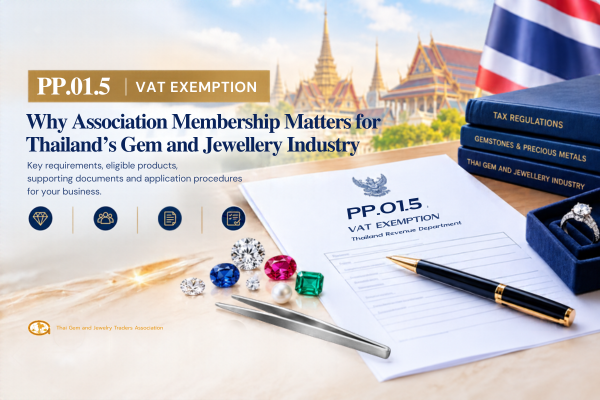
Learn about Thailand’s PP.01.5 VAT exemption, eligible gemstones and precious metals, association membership requirements, supporting documents, and application procedures for gem and jewellery businesses.
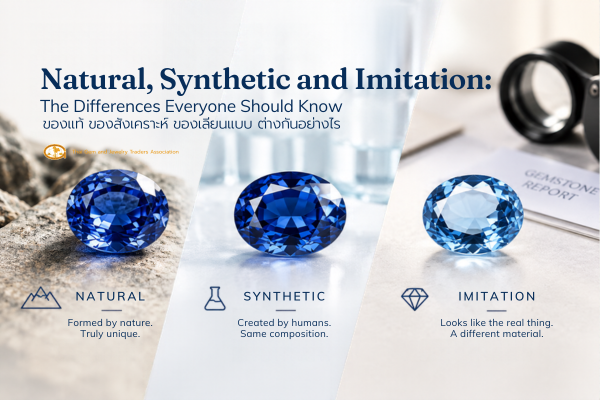
Discover the differences between natural, synthetic and imitation materials. Learn why origin, rarity and authenticity matter, and what consumers should know before purchasing valuable items.

Explore Oval, Marquise, Pear and Cushion gemstone shapes, how to select them for contemporary jewellery design, and how proportions, cutting quality, rarity and market demand influence value.