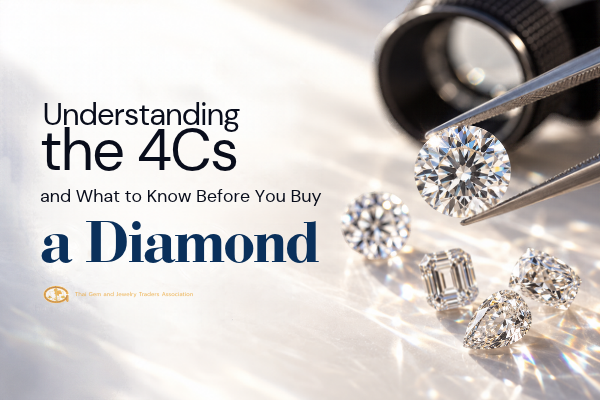
Diamonds are popular choices for engagement rings, gifts, fine jewellery and special occasions. However, buying a diamond can be confusing, especially when shoppers encounter terms such as Carat, Cut, Colour and Clarity, or need to understand the differences between natural diamonds and laboratory-grown diamonds.
Choosing the right diamond is not simply about finding the largest stone or the highest grades. It is about understanding the diamond's characteristics, checking reliable documentation and selecting a stone that suits your preferences and budget.
The Gemological Institute of America (GIA) established the 4Cs as an internationally recognised framework for describing diamond quality. The four factors are Cut, Colour, Clarity and Carat Weight. Together, they help consumers understand diamond characteristics and compare stones more effectively.
Cut affects how a diamond interacts with light, influencing its brightness, sparkle and the flashes of colour known as fire.
Two diamonds with the same carat weight can look very different if their cutting quality and proportions differ.
For round brilliant diamonds, consumers should consider the cut grade alongside the stone's overall appearance rather than focusing solely on carat weight or colour.
Under GIA's D-to-Z colour grading scale, diamonds are graded according to their degree of colourlessness. Grade D represents colourlessness, while lower grades within this scale show increasing traces of yellow or brown.
Fancy-colour diamonds, such as pink or intensely coloured yellow diamonds, belong to a different grading category and are assessed using different colour-grading principles.
Clarity refers to the characteristics present within a diamond, known as inclusions, and those affecting its surface, known as blemishes. Their size, number, position and visibility influence the clarity grade.
A higher clarity grade does not necessarily mean that a diamond will look noticeably more attractive to the naked eye. Some inclusions may be difficult to see without magnification.
Consumers should therefore consider the clarity grade together with the diamond's actual appearance.
Carat is a unit of weight, not a direct measurement of a diamond's physical size. One carat equals 0.20 grams.
Diamonds of the same carat weight can appear different in size depending on their shape and cutting proportions. A heavier diamond is not automatically of higher quality, nor does it always offer a lower price per carat.
The key takeaway: The 4Cs should be considered together. No single factor fully determines a diamond's overall quality, appearance or market value.
Understanding a diamond's origin is essential when comparing products, prices and purchasing options.
Natural diamonds form through geological processes within the Earth over extended periods. They are recovered through mining and subsequently cut and polished for use in jewellery.
Laboratory-grown diamonds are produced using technological processes that create conditions in which carbon crystallises into diamond. The two principal production methods are High Pressure High Temperature (HPHT) and Chemical Vapour Deposition (CVD).
From a scientific perspective, natural and laboratory-grown diamonds are both composed primarily of carbon and have closely comparable physical and optical properties. Consequently, they cannot be reliably distinguished by visual inspection alone. Identifying their origin may require specialised instruments and examination by a qualified gemmological laboratory.
Their principal difference lies in their origin and production process, as well as their market context. Buyers should confirm which type of diamond is being offered and compare prices and product disclosures accordingly.
Diamond simulants, such as cubic zirconia, are materials used to imitate the appearance of diamonds. They do not have the same chemical composition and crystal structure as diamond.
This distinction is important: a laboratory-grown diamond is diamond, whereas a simulant is a different material that resembles diamond in appearance.
Before purchasing a diamond, particularly one of significant value, consumers should ask whether a grading or identification report from a gemmological laboratory is available.
Depending on the laboratory and report type, the document may include:
Diamond type: Whether the stone is natural or laboratory-grown.
Carat weight: The measured weight of the diamond.
Colour and clarity grades: Assessments according to the laboratory's grading system.
Cut grade: Where applicable, details of the diamond's cutting quality.
Report number and other identifying details: Information that helps consumers verify the report and match it to the stone.
Consumers should check the report number through the issuing laboratory's official verification service and compare the report details with the diamond they intend to purchase. If the diamond has a laser-inscribed report number, this can also be checked where applicable.
However, a grading report is not a price guarantee or an assurance of future resale value. Different reports may have different purposes and scopes, so buyers should understand what the document does and does not establish before relying on it.
Choosing a diamond with confidence begins with understanding the 4Cs, recognising the differences between natural diamonds, laboratory-grown diamonds and diamond simulants, and checking the documentation provided by the seller.
The most suitable diamond is not necessarily the largest or the one with the highest grades. It is the diamond whose characteristics, documentation and price align with your needs and budget.
Being informed before buying helps consumers compare products more effectively and supports greater transparency and confidence throughout the gem and jewellery industry.
[1] Gemological Institute of America (GIA). Understanding the 4Cs of Diamond Quality.
https://4cs.gia.edu/en-us/4cs-of-diamond-quality/
[2] Gemological Institute of America (GIA). Diamond Quality Factors.
https://www.gia.edu/diamond-quality-factor
[3] Gemological Institute of America (GIA). Is There a Difference Between Natural and Laboratory-Grown Diamonds?
https://www.gia.edu/gia-news-research/difference-between-natural-laboratory-grown-diamonds
[4] Federal Trade Commission (FTC), United States. Jewelry Guides: Helping Consumers Understand What They’re Buying.
https://www.ftc.gov/news-events/topics/tools-consumers/jewelry-guides
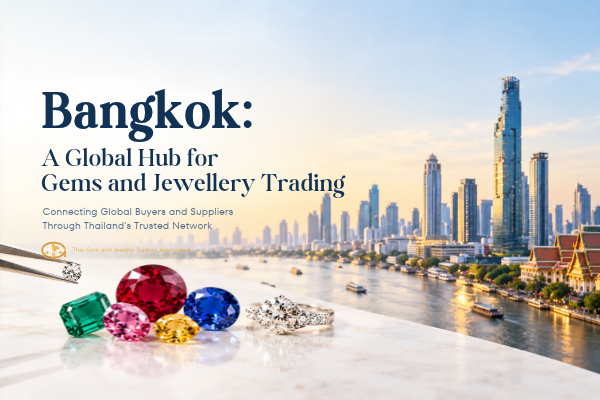
Explore Bangkok’s role in global coloured gemstone trading through Mahesak Road, Silom–Surawong, Yaowarat and Charoen Krung, where specialised business networks support Thailand’s gems and jewellery industry.
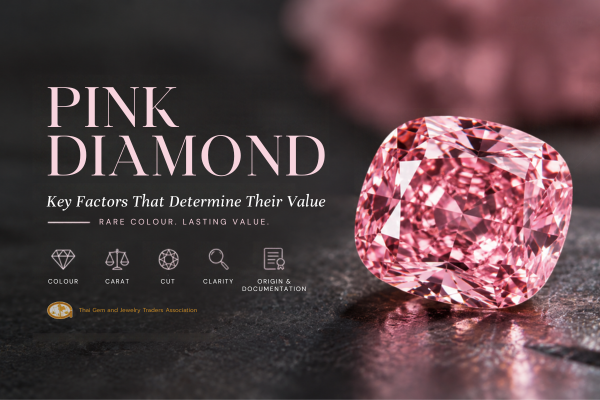
Discover how natural pink diamonds get their colour and how colour grade, carat weight, cut, clarity, provenance and laboratory reports influence their market value.

Hong Kong imported nearly 100 tonnes of Russian gold in the first seven months of 2026, highlighting shifting global trade routes, China's growing role and sanctions compliance risks.