
.png)
Colour is one of the first elements people perceive when looking at a piece of jewellery. Alongside the gemstone, cut, shape and metal, colour can contribute to the overall impression, emotional response and visual identity of a piece.
Research in colour psychology has found systematic associations between certain colours and emotions. However, these associations are not universal rules. The way people perceive colour can also depend on hue, lightness, saturation, context and cultural background.
A 2025 systematic review of research on colour and emotion, covering 132 studies and more than 42,000 participants across 64 countries, found systematic patterns in colour–emotion associations. However, the researchers also emphasised that these relationships are complex and often many-to-many: one colour can be associated with several emotions, while the same emotion can be associated with different colours.
Therefore, when discussing the psychology of colour in jewellery, it is more accurate to view colour as a visual language that can influence perception and communicate meaning, rather than as something that produces the same emotional response in everyone.
Example gemstones: Ruby, Garnet and Red Diamond
Red is strongly associated with high-arousal emotions. Research has linked red with both positive and negative emotional states, including love, passion and energy, as well as anger and other negative emotions in certain contexts.
In the world of gemstones, Ruby has considerable historical significance and is one of the traditional Big Three coloured gemstones, together with Sapphire and Emerald. The colour of Ruby is also a major factor in its evaluation and desirability.
Red can create an impression that is bold, confident, energetic and attention-grabbing. It can therefore be particularly effective when the gemstone is intended to become the visual focal point of a jewellery design.
Example gemstones: Sapphire, Blue Topaz, Tanzanite and Blue Diamond
Blue is commonly associated with positive, lower-arousal emotions such as calmness and relaxation. However, blue can also be associated with sadness in certain contexts, demonstrating why colour meanings should not be treated as fixed or universal.
Sapphire is one of the Big Three coloured gemstones and is particularly well known for its blue varieties. However, sapphire occurs in a wide range of colours, with non-blue varieties generally described as fancy sapphires.
Blue can create an impression of calmness, elegance, stability and sophistication. It works particularly well in jewellery intended for formal occasions as well as designs with a timeless aesthetic.
Example gemstones: Emerald, Peridot, Green Tourmaline and Green Diamond
Research suggests that green tends to be associated with positive emotions and relatively low levels of arousal, including feelings of comfort and relaxation.
Because green is strongly associated with the natural environment, it is also commonly used in design to evoke ideas of nature, freshness, growth and balance.
Emerald is one of the Big Three coloured gemstones, alongside Ruby and Sapphire, and is distinguished by its characteristic green colour.
Green can create a feeling of natural freshness, balance and elegance. It can also support design narratives associated with growth, renewal and a new chapter in life.
Example gemstones: Citrine, Yellow Diamond, Yellow Sapphire and Yellow Topaz
Yellow tends to be associated with positive emotions and relatively high levels of arousal. Research has found associations between yellow and emotions such as happiness, amusement and excitement.
In jewellery design, yellow can therefore contribute to an impression that is bright, cheerful, lively and energetic.
When combined with yellow gold, the gemstone can create a particularly warm and visually cohesive appearance.
Yellow is well suited to jewellery intended to express optimism, vitality and a sense of joy, particularly when colour is an important part of the design concept.
Example gemstones: Amethyst, Tanzanite and Purple Sapphire
Purple has a distinctive relationship with emotion. Research suggests that purple can be associated with emotions related to power and empowerment, although its interpretation can vary considerably depending on context.
In visual design, purple can also create an impression of complexity, individuality and intrigue.
Purple can be particularly effective for designs intended to appear distinctive, imaginative and contemporary, offering an alternative to more traditional red, blue or colourless gemstones.
Example gemstones: Pink Sapphire, Morganite and Pink Diamond
Pink tends to be associated with positive emotional responses. In everyday culture and jewellery design, it is frequently connected with ideas of love, affection, warmth and tenderness.
However, these associations can vary according to the particular shade and the context in which the colour is presented.
Light pink can create a soft, delicate and romantic impression, while deeper and more saturated pinks can appear more vivid, expressive and energetic.
This illustrates why the colour category alone is not enough to describe the visual character of a gemstone.
Example gemstones: Colourless Diamond, White Sapphire and White Pearl
Research suggests that white tends to be associated with positive emotions and relatively low levels of arousal.
In jewellery, colourless gemstones such as diamond also demonstrate that visual appeal is not determined by colour alone. Light return, brilliance, dispersion and the quality of cutting can play an important role in how a gemstone is perceived.
For coloured gemstones, colour characteristics such as hue, tone and saturation are also important when describing and evaluating appearance.
White and colourless gemstones can create an impression of clarity, simplicity, elegance and timelessness, making them suitable for a wide range of jewellery styles and occasions.
Example gemstones: Black Diamond, Onyx and Black Spinel
Research indicates that black tends to be associated with high-arousal negative emotions, including fear and anger, rather than having a single universal meaning such as “power” or “luxury”.
In fashion and jewellery design, however, black can be deliberately used to create a very different visual impression, including mystery, sophistication, sharpness and modernity.
Black gemstones can be particularly effective in designs intended to express strength, contrast, individuality and a contemporary aesthetic.
When discussing gemstone colour, simply identifying a stone as red, blue or green does not tell the whole story.
Different variations of the same basic colour can create very different visual impressions.
In gemmology, colour in coloured gemstones is commonly described using three key components:
Hue refers to the basic colour family, such as red, blue, green or yellow.
Two gemstones may belong to the same general colour family but display different hues because of subtle differences in their colour characteristics.
Tone refers broadly to how light or dark a colour appears.
A lighter and a darker version of the same hue can create distinctly different visual impressions.
For example:
Light pink → soft, delicate and subtle
Deep pink → vivid, expressive and energetic
Saturation describes the strength or intensity of a colour.
A highly saturated gemstone can appear vivid and strong, while a gemstone with lower saturation may appear softer, more subdued or muted.
In coloured gemstones, hue, tone and saturation are important components of colour description and evaluation. The way these characteristics are perceived can also influence the overall visual impression of jewellery.
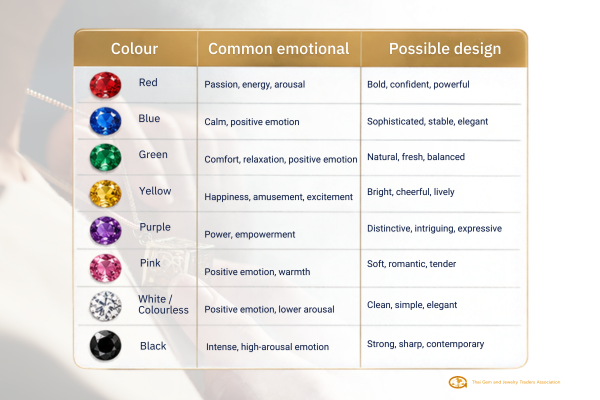
When colour psychology is applied to jewellery design, colour can be viewed as a visual language that helps establish the personality of a piece.
| Colour | Common emotional associations | Possible design impression |
|---|---|---|
| Red | Passion, energy, arousal | Bold, confident, powerful |
| Blue | Calm, positive emotion, lower arousal | Sophisticated, stable, elegant |
| Green | Comfort, relaxation, positive emotion | Natural, fresh, balanced |
| Yellow | Happiness, amusement, excitement | Bright, cheerful, lively |
| Purple | Power, empowerment | Distinctive, intriguing, expressive |
| Pink | Positive emotion, warmth | Soft, romantic, tender |
| White / Colourless | Positive emotion, lower arousal | Clean, simple, elegant |
| Black | Intense, high-arousal emotion | Strong, sharp, contemporary |
Important: This table describes general patterns of colour perception and association. It should not be interpreted as a fixed psychological rule or as a prediction of an individual's personality.
Choosing a jewellery colour can be viewed as more than simply selecting a gemstone that looks attractive. It can also be a way of choosing the visual message or mood that the wearer wishes to express.
A red gemstone may be chosen to create a bold and energetic impression.
Blue may be selected for a sense of elegance, calmness and sophistication.
Green may appeal to those drawn to natural, fresh and balanced aesthetics.
Yellow can introduce brightness and vitality.
Purple can create a more distinctive and intriguing visual identity.
Pink can support a softer and more romantic aesthetic.
White or colourless gemstones can communicate simplicity and timeless elegance.
Black gemstones can create a strong, modern and distinctive appearance.
However, these interpretations should not be used to define the personality of the wearer. Personal experiences, memories, cultural background and individual preferences can all influence how colour is perceived.
In reality, colour is only one of several elements that shape the overall perception of a jewellery piece.
Gemstone + Colour + Cut + Metal + Form + Light + Context
All of these elements interact to create the final visual impression.
For example, a deep blue gemstone set in a white metal and precision-cut design may create a very different impression from a lighter blue gemstone set in yellow gold, even though both are fundamentally “blue”.
This is particularly important when discussing coloured gemstones. Colour should not be reduced to a simple colour name because its visual character depends on multiple characteristics and how they interact with the finished jewellery design.
Colour can play an important role in how jewellery is perceived, from the first visual impression to the mood and story that a design communicates.
Red may suggest passion and energy.
Blue may suggest calmness and stability.
Green may evoke nature and freshness.
Yellow may suggest optimism and vitality.
Purple may create a sense of distinction and intrigue.
Pink may evoke warmth and tenderness.
White and colourless gemstones may communicate simplicity and elegance.
Black may create a strong, contemporary and distinctive impression.
Yet colour psychology does not mean that one colour will make everyone feel the same way.
Current research supports systematic relationships between colour and emotion, while also showing that these relationships are complex and influenced by hue, lightness, saturation, context and culture.
Ultimately, jewellery does more than reflect light. Through colour, design and craftsmanship, it can also reflect emotion, communicate a story and express the identity that the wearer wishes to present.
Research has identified systematic associations between colour and emotion, but this does not mean that a particular colour will produce the same emotional response in everyone. Perception can vary according to hue, lightness, saturation, context and cultural background.
Red is commonly associated with high-arousal emotions and can be connected with passion, love, energy and excitement, while also being associated with anger or other negative emotions in certain contexts.
Blue is often associated with calmness, relaxation and positive emotions with relatively low arousal. However, blue can also be associated with sadness in some contexts.
Green is commonly associated with comfort, relaxation and positive emotions. In design, it is also frequently connected with nature, freshness, growth and balance.
Yellow is often associated with happiness, amusement, excitement and other positive emotions. In jewellery design, it can create a bright and lively impression.
Research suggests that purple can be associated with emotions related to power and empowerment. In jewellery and visual design, it can also create a distinctive, intriguing and expressive impression.
Pink is commonly associated with positive emotions and, in many cultural and design contexts, with love, affection and tenderness. However, these associations are not universal and can vary according to context and culture.
Black is associated in colour research with intense, high-arousal emotions, including some negative emotions. In fashion and jewellery design, however, black can also be used to create impressions of mystery, strength, sophistication, sharpness and modernity.
Hue refers to the basic colour family, such as red, blue or green. Tone describes how light or dark the colour appears, while saturation refers to the strength or intensity of the colour. These characteristics are important when describing and evaluating the colour of coloured gemstones.
Yes, colour can be a major value factor for many coloured gemstones. However, value is not determined by colour alone. Other factors may include clarity, cut, carat weight, durability, treatments, origin and market conditions, depending on the gemstone.
No. Colour psychology is better understood as the study of relationships and associations between colour and psychological or emotional responses. Research supports systematic patterns, but colour perception is complex and influenced by individual, cultural and contextual factors.
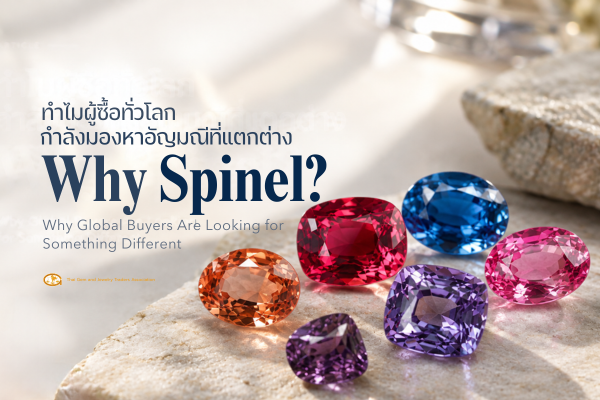
Discover Spinel, a coloured gemstone gaining attention for its distinctive colours, rarity and unique characteristics. Learn how Spinel differs from ruby and what to consider before buying.
Explore the Gemports GTI Q2 2026 analysis of ruby and sapphire markets, including large-carat price trends, transaction volumes, capital rotation and Q3 outlook.
Pearls are organic gemstones with unique structures and properties, which means they require different care from many other gemstones and precious metals.