
The Gemports GTI Q2 2026 data presents a market for ruby and sapphire that is beginning to show signs of stabilisation in the high-quality segment, although the overall Gemports Transaction Index (GTI) for both markets continued to decline quarter on quarter.
A key development during the quarter was the improvement in prices for selected large-carat stones, while commercial-grade segments continued to face pressure. The entry of participants from the gold and other tangible-asset markets also provided additional liquidity and price support in parts of the market.
Note: This article summarises the Gemports GTI Q2 2026 analysis for the ruby and sapphire markets. All figures and market observations presented here are based on the source documents provided.
The Gemports Transaction Index (GTI) reflects market movements based on executed transactions. In the Q2 2026 analysis, movements in the index were influenced by both price levels and transaction volumes across different market segments.
An important point when interpreting the GTI is that the overall index can decline even when prices in certain segments increase, particularly when higher-volume segments continue to experience price pressure.
This dynamic was particularly evident in the ruby and sapphire markets during Q2 2026.
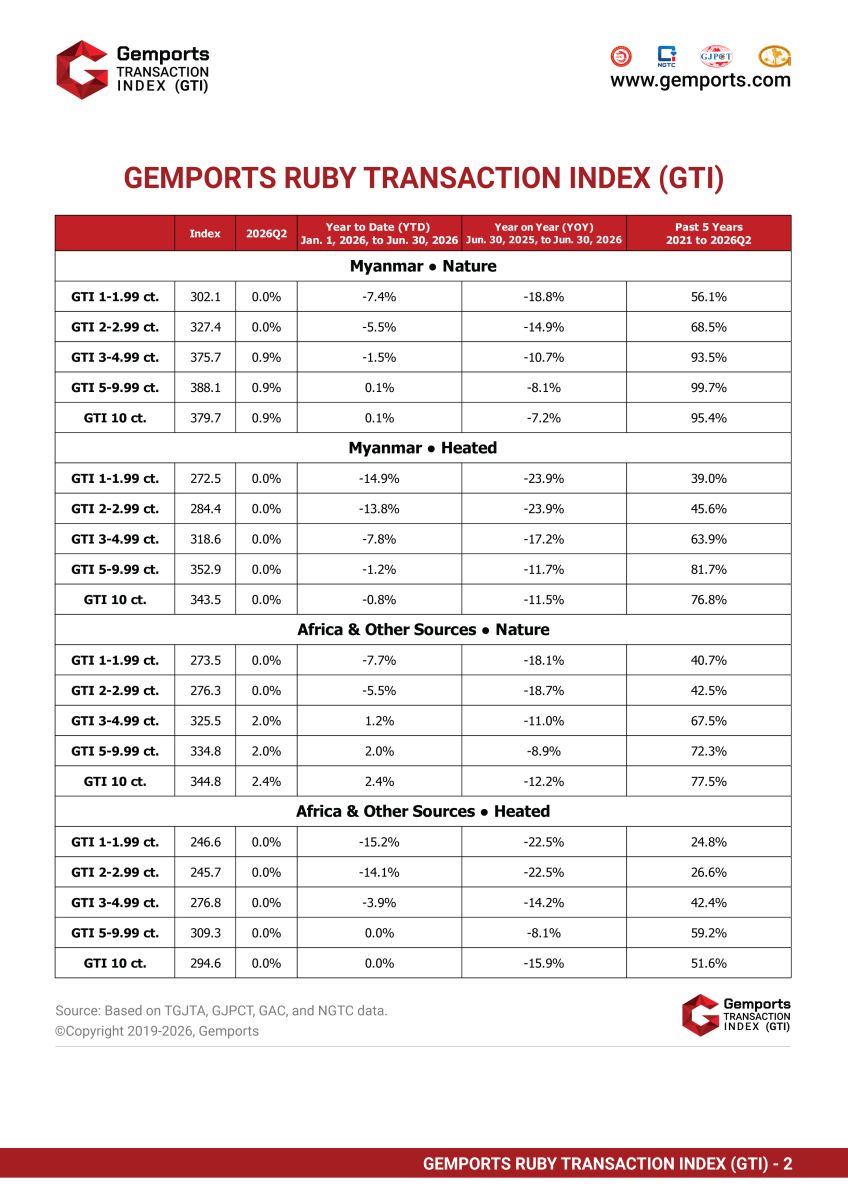
The Q2 2026 ruby market showed a clear divergence between large-carat, high-quality material and the commercial segment.
Natural, unheated rubies of 3 carats and above recorded price increases of approximately 3–7% quarter on quarter (QoQ). This represented a positive price signal for the segment.
However, the overall Ruby GTI continued to decline. The sub-3-carat segment accounts for the majority of transaction volume and remained under price pressure, giving it greater weight in the volume-weighted index than the lower-volume large-carat segment.
| Category | QoQ Change | YoY Change |
|---|---|---|
| Natural Ruby – Myanmar | −6.2% | −44.1% |
| Natural Ruby – Africa & Other Sources | −1.9% | −41.1% |
| Heated Ruby – Myanmar | −5.7% | −44.5% |
| Heated Ruby – Africa & Other Sources | −3.0% | −39.0% |
The figures above are the Ruby GTI figures reported in the Gemports Q2 2026 analysis.
One of the most significant developments during the quarter was the entry of buyers from the hard-asset sector, particularly gold traders, precious-metals operators and participants in other physical-asset markets.
These participants began entering the certified large-carat ruby market, providing additional demand and price support in the 3–10 carat natural unheated segment, even though broader consumer demand had not yet meaningfully recovered.
Supply constraints also remained an important structural factor. The Gemports analysis noted that production from major ruby-producing regions had not increased meaningfully.
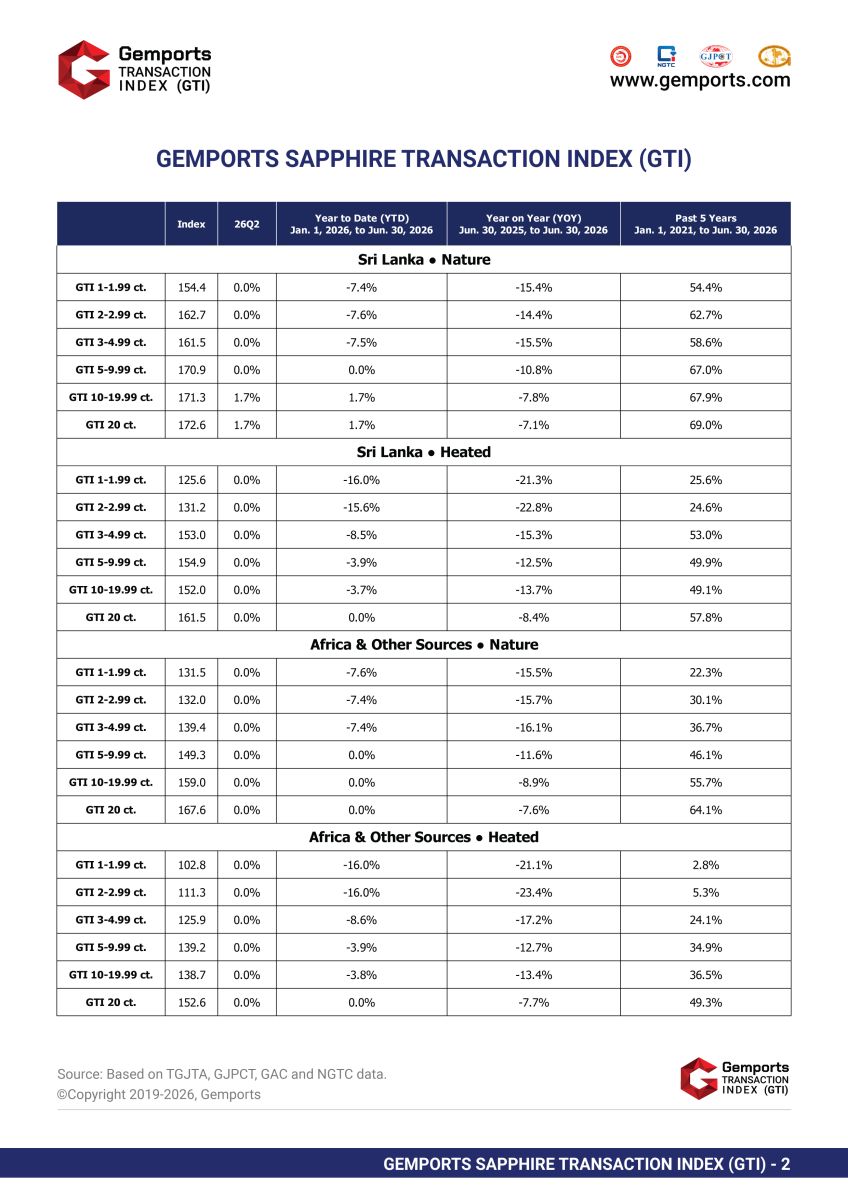
The sapphire market also showed early signs of stabilisation in Q2 2026.
Sapphires in the 10–20 carat and larger categories recorded price increases of approximately 5% QoQ. According to the Gemports analysis, this was the first meaningful improvement since the market correction began in Q3 2025.
However, the improvement in large-carat prices was not sufficient to reverse the overall Sapphire GTI. Transactions in the 1–10 carat range continued to significantly outnumber those in the large-carat segment, giving the commercial and mid-size market greater weight in the index.
| Category | QoQ Change | YoY Change |
|---|---|---|
| Natural Sapphire – Sri Lanka | −1.5% | −32.6% |
| Natural Sapphire – Africa & Other Sources | −0.9% | −34.6% |
| Heated Sapphire – Sri Lanka | −1.8% | −34.9% |
| Heated Sapphire – Africa & Other Sources | −1.0% | −35.6% |
The figures above are the Sapphire GTI figures reported in the Gemports Q2 2026 analysis.
Sapphires below 5 carats from Sri Lanka and Africa remained under price pressure during Q2. However, the rate of decline slowed noticeably compared with Q1, consistent with the stabilising effect of new capital entering the broader coloured gemstone market.
One of the key points in interpreting the Q2 2026 data is the apparent divergence between price movements in premium segments and the direction of the overall GTI.
The explanation lies in the structure of transaction volume.
In the ruby market, sub-3-carat stones account for the majority of transactions, while natural rubies in the 3–10 carat range have much lower transaction frequency. Although prices in the large-carat segment increased, the lower transaction volume limited its influence on the overall index.
A similar pattern occurred in the sapphire market. Transactions in the 1–10 carat range remained substantially higher than those in the large-carat segment. As a result, improvements in large-carat prices were not sufficient to offset continued weakness in the higher-volume segments.
The Q2 2026 data therefore shows why both price movements and transaction composition are important when interpreting the GTI.
Another notable theme in the Gemports Q2 2026 analysis is capital rotation.
Both the ruby and sapphire markets saw increased participation from gold traders and participants in tangible-asset markets. This provided additional liquidity and supported prices in selected segments, particularly large-carat and higher-quality natural gemstones.
At the same time, the analysis indicates that end-consumer demand had not yet meaningfully recovered. Therefore, the additional capital entering the market should not be interpreted as evidence of a broad-based recovery across the entire coloured gemstone market.
The Gemports analysis identifies several factors to monitor during Q3 2026.
Gold prices may influence capital allocation between different asset classes, including capital that moved into coloured gemstones during Q2. The direction of gold prices is therefore identified as an important indicator for sapphire market liquidity.
Changes in geopolitical conditions, particularly the US–Iran situation, were identified as a factor that could affect cross-border gemstone transactions and market participation.
For the ruby market, easing geopolitical tensions could also support transaction activity in the investment-grade segment.
A recovery in retail demand, combined with constrained supply of large natural gemstones, could provide further support for higher-quality segments.
For rubies, supply constraints remain a key structural factor. The Gemports analysis notes that production from major ruby-producing regions has not increased meaningfully.
The Gemports GTI Q2 2026 data indicates that the ruby and sapphire markets remain in a period of adjustment, with early signs of price stabilisation emerging in the large-carat, high-quality segments while commercial-grade markets continue to face pressure.
Natural, unheated rubies of 3 carats and above recorded price gains of approximately 3–7% QoQ, while sapphires in the 10–20 carat and larger categories increased by approximately 5% QoQ.
Nevertheless, the overall GTI for both markets continued to decline because higher-volume segments remained under pressure.
The Q2 2026 results therefore illustrate that the coloured gemstone market is not moving uniformly. Market performance varies according to carat size, quality, transaction volume and supply conditions.
Understanding these differences is important when interpreting market indicators and assessing developments in the global coloured gemstone market.
Read the full Gemports analysis:

Pearls are organic gemstones with unique structures and properties, which means they require different care from many other gemstones and precious metals.

Looking back through history, gemstones and jewelry have often been portrayed as symbols of love, traditionally given by men to women. Over the past decade, however, leading global jewelry publications and industry media have highlighted a significant par

Today, we proudly announce the outstanding designers whose works were selected by the international jury to receive the Gemports Award 2026.