
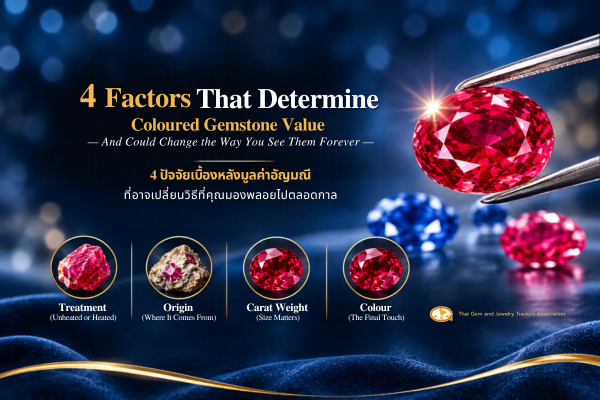
Beyond Beauty: Understanding What Really Determines a Gemstone’s Value
When people think of gemstones, they often associate them with beauty, colour, brilliance and luxury. Yet, in the gemstone trade, appearance is only part of the story.
Behind every gemstone lies a complex set of factors that influence its market value. These include treatment history, geographical origin, carat weight and subtle differences in colour. Even gemstones that appear similar in size, colour and overall quality can command significantly different prices.
Understanding these factors provides a deeper insight into the coloured gemstone market and explains why certain rubies and sapphires are considerably more valuable than others.
Here are four key factors that shape gemstone value, illustrated with pricing data from the Gemports Coloured Gemstone Report Q3 2026.
Two gemstones may look almost identical, yet their values can differ considerably depending on their treatment history.
Heat treatment is one of the most established methods used in the gemstone industry to improve the colour and, in some cases, the apparent clarity of rubies and sapphires. It is an accepted industry practice, provided that the treatment is properly disclosed.
However, high-quality gemstones that show no indications of heat treatment are generally rarer and may command a significant price premium, particularly among collectors and buyers in the high-end gemstone market.
According to the Gemports Ruby Report Q3 2026, the reference prices for natural Vivid Red rubies from Myanmar weighing 3–4.99 carats are as follows:
| Treatment Status | Reference Price per Carat |
|---|---|
| Nature (Unheated) | USD 153,670 |
| Heat (Heated) | USD 35,930 |
The Nature category commands approximately 4.28 times the reference price of the Heat category, representing a difference of approximately 328%.
This illustrates the importance of treatment history in the high-quality ruby market. The premium is associated with the rarity of fine-quality rubies that have retained their natural characteristics without evidence of heat treatment.
The Gemological Institute of America (GIA) explains that most rubies in the market have undergone heat treatment. Rubies confirmed by independent gemmological laboratories to show no indications of heat treatment are generally rarer and may command higher prices.
What consumers should know: It is not possible to reliably determine whether a ruby has been heat-treated through visual inspection alone. Professional examination by a recognised gemmological laboratory is important, particularly when purchasing high-value gemstones. Heat treatment itself does not necessarily mean that a gemstone is of inferior quality.
Gemstones of the same variety, even with similar colour and quality, may have substantially different market values depending on their geographical origin.
In the ruby market, Myanmar, particularly the historic Mogok mining region, has long been recognised as an important source of fine-quality rubies. Exceptional rubies from this origin often command an origin premium compared with stones from other sources.
The Gemports Q3 2026 report provides the following reference prices for natural Vivid Red rubies weighing 10.00 carats:
| Origin | Nature (USD/ct) | Heat (USD/ct) |
|---|---|---|
| Myanmar | 1,647,640 | 443,520 |
| Africa and Other Sources | 542,650 | 125,740 |
For the Nature category, Myanmar rubies have a reference price approximately 3.04 times higher than those from Africa and Other Sources.
This difference reflects several factors, including rarity, the historical reputation of the origin, gemmological characteristics and market demand.
One particularly interesting characteristic is fluorescence, a phenomenon in which certain gemstones emit visible light when exposed to ultraviolet (UV) radiation.
Rubies contain chromium, which is responsible for their red colour. In some rubies, relatively low iron content allows stronger red fluorescence because iron can suppress fluorescence.
This phenomenon can contribute to the appearance of an internal glow, particularly under natural light containing UV radiation.
However, not every ruby from Myanmar displays strong fluorescence, nor does origin alone guarantee superior quality. Chemical composition and gemmological characteristics vary between deposits and individual stones.
GIA also emphasises that geographical origin alone does not determine gemstone quality. Even a renowned mining region can produce gemstones across a wide range of quality levels.
What consumers should know: Origin premium is an important consideration in the gemstone market, but origin determination requires specialised laboratory examination. Gemmologists may use internal characteristics, trace-element analysis and spectroscopic techniques to assess geographical origin. Appearance alone cannot reliably establish where a gemstone was mined.
Many people assume that a 2-carat gemstone should be worth twice as much as a 1-carat stone. In reality, gemstone pricing does not always follow a linear relationship.
For high-quality coloured gemstones, larger stones are considerably rarer, especially when they retain excellent colour, clarity and cutting proportions. As a result, the price per carat can increase dramatically with size.
The Gemports Ruby Report Q3 2026 illustrates this relationship through the following reference prices:
| Weight Range | Reference Price per Carat (USD) | Compared with 1–1.99 ct |
|---|---|---|
| 1–1.99 ct | 24,160 | 1× |
| 2–2.99 ct | 51,360 | 2.13× |
| 3–4.99 ct | 153,670 | 6.36× |
| 5–9.99 ct | 461,340 | 19.09× |
| 10.00 ct | 1,647,640 | 68.19× |
The figures show that a 10-carat Myanmar Vivid Red ruby has a reference price per carat approximately 68 times higher than the 1–1.99-carat category.
This demonstrates how rarity becomes increasingly important as gemstone size increases.
The relationship is closely connected to the economic principles of scarcity and supply. Large gemstones of exceptional quality are uncommon, and achieving attractive proportions while preserving as much weight as possible requires considerable cutting expertise.
GIA also highlights the significant influence of size on ruby pricing, particularly among fine-quality stones.
What consumers should know: When evaluating a gemstone, do not consider total carat weight alone. Price per carat should be assessed alongside colour, clarity, cutting quality, geographical origin and treatment history.
Among the factors influencing gemstone value, colour is particularly important for high-quality rubies and sapphires.
Small differences in hue, saturation and tone can have a substantial impact on price, even when gemstones have similar weights and origins.
For example, a ruby with a vivid, highly saturated red colour and minimal secondary hues may be more desirable than one displaying excessive purplish or orangish tones.
According to the Gemports Ruby Report Q3 2026, the reference prices for natural Myanmar rubies weighing 3–4.99 carats are:
| Colour Category | Reference Price per Carat (USD) |
|---|---|
| Vivid Red | 153,670 |
| Intense Red | 134,270 |
| Deep Red | 93,350 |
| Red | 93,280 |
The Vivid Red category commands a reference price approximately 64.6% higher than the Deep Red category.
This comparison demonstrates how colour grading can influence gemstone value, even when origin, weight range and treatment category are comparable.
The terms Pigeon Blood Red, used for rubies, and Royal Blue, used for sapphires, are recognised trade colour descriptions associated with highly desirable gemstone colours.
However, these terms do not have one universally adopted scientific colour definition shared by all gemmological laboratories.
The Swiss Gemmological Institute (SSEF), for example, has established its own criteria for these colour descriptions. Its assessment considers multiple characteristics rather than colour appearance alone.
For Pigeon Blood Red rubies, relevant considerations include:
Colour: A vivid red colour with minimal purplish influence.
Fluorescence: Distinct red fluorescence under UV radiation, according to the laboratory's criteria.
Treatment: No indications of treatment.
Clarity and Transparency: Suitable transparency and internal characteristics.
Cut and Proportions: Appropriate cutting proportions without an undesirable window effect.
Importantly, a ruby from another geographical origin may also qualify for the Pigeon Blood Red description if it meets the laboratory's assessment criteria. The term is not exclusively reserved for rubies from Myanmar.
It is therefore essential to distinguish between trade colour descriptions, individual laboratory terminology and the colour categories used in gemstone pricing reports.
What consumers should know: High-level colour descriptions should be supported by clearly defined assessment criteria. When purchasing valuable rubies or sapphires, buyers should check which laboratory issued the report and how the colour description was determined.
The traditional 4Cs – Cut, Colour, Clarity and Carat – provide a useful foundation for understanding gemstone characteristics. However, the valuation of coloured gemstones involves additional considerations.
Key factors include:
Colour: Hue, saturation and tone, which determine the overall visual appearance and desirability of a gemstone.
Clarity: Transparency and the nature, size and position of internal inclusions.
Cut: Cutting style and proportions, which influence appearance, brilliance and the overall presentation of the gemstone.
Carat Weight: Weight and the relative rarity of gemstones within a particular size category.
Origin: Geographical origin, which may influence market demand and price premiums.
Treatment: The history of any processes used to improve or alter a gemstone's appearance, which can affect rarity and market value.
No single factor determines a gemstone's value. A comprehensive assessment requires all relevant characteristics to be considered together, alongside prevailing market conditions and buyer demand.
For consumers, collectors and industry professionals, access to structured pricing information is an important tool for understanding the coloured gemstone market.
The Gemports Coloured Gemstone Report is a reference pricing resource developed through the collaboration of four organisations. It provides structured price information according to gemstone variety, geographical origin, carat weight, colour and treatment status.
The reports are published quarterly, allowing users to examine reference prices and compare different gemstone categories over time.
The Q3 2026 report uses an exchange-rate reference date of 30 September 2026. Its pricing framework applies specified quality criteria, including eye-clean clarity, cutting quality and oval shape.
It is important to note that the prices shown are reference prices based on the report's defined criteria. They are not guaranteed transaction prices, and actual market prices may vary depending on the individual gemstone, documentation, buyer demand and transaction conditions.
Ultimately, the value of a gemstone goes far beyond what the eye can see. Its natural characteristics, treatment history, geographical origin and verifiable information all contribute to the story behind its value.
Explore the latest reference prices for rubies and sapphires at:
1. Gemports – Coloured Gemstone Price Reports
2. Gemological Institute of America (GIA)
Ruby Quality Factors – An overview of the factors affecting ruby quality and value.
GIA – Ruby Heat Treatment – Information about heat treatment and its relationship with ruby value.
3. Swiss Gemmological Institute (SSEF)
Colour Terms: Pigeon Blood Red and Royal Blue – Laboratory criteria and the use of these colour descriptions.
Data Note: All Gemports pricing examples in this article are based on the Q3 2026 Ruby Report supplied for reference. Nature and Heat are the report's respective pricing categories and should not be interpreted as a guarantee regarding every possible type of treatment. Prices are expressed in US dollars per carat (USD/ct).

รู้จักองค์กรสำคัญในอุตสาหกรรมเพชรโลก ตั้งแต่ Kimberley Process, CIBJO, WFDB, WDC, GIA ไปจนถึงสมาคมการค้าและหน่วยงานกำกับดูแล ที่มีบทบาทต่อมาตรฐาน ความโปร่งใส และความเชื่อมั่นในตลาดเพชร
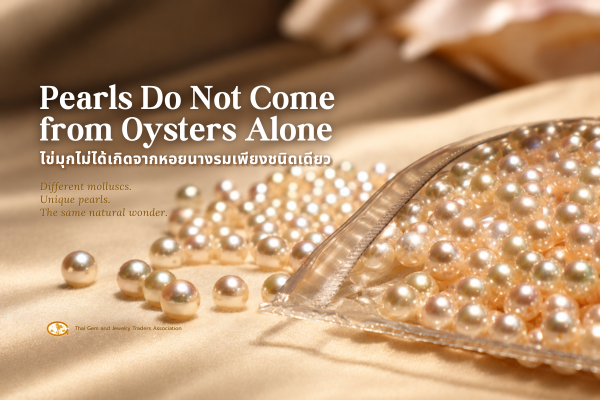
Discover six groups of molluscs that can produce pearls, from pearl oysters and freshwater mussels to Queen Conch, Melo and abalone. Explore pearl structures, gemmological properties, Mother-of-Pearl and quality assessment.
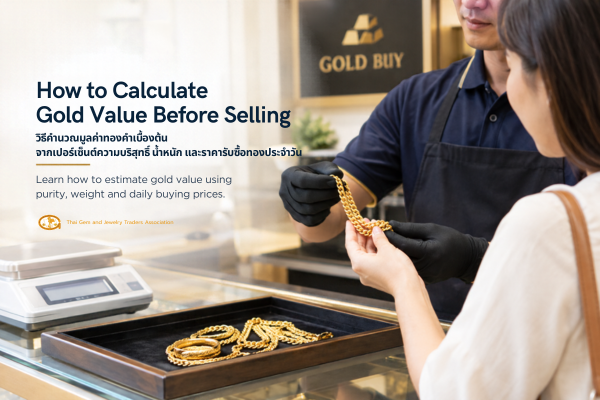
Learn how to estimate gold value using purity, weight and daily buying prices. Explore simple formulas and examples to help you assess your gold before selling.