The global diamond industry operates through a complex supply chain, encompassing mining, cutting and polishing, trading, and retail distribution. Each stage involves different organisations responsible for establishing standards, overseeing trade practices, promoting responsible sourcing, and supporting consumer confidence.
These organisations include intergovernmental bodies, international trade associations, industry councils, standard-setting organisations, regulatory authorities, and gemmological laboratories. Understanding their respective roles provides valuable insight into how the global diamond industry operates.
Kimberley Process (KP)
The Kimberley Process is an intergovernmental initiative established to prevent the trade in conflict diamonds. It originated in May 2000, when diamond-producing countries met in Kimberley, South Africa, to discuss measures to stop diamonds from being used to finance armed conflicts and undermine legitimate governments.
The Kimberley Process Certification Scheme (KPCS) was formally launched in 2003. Under this scheme, rough diamonds traded internationally between participating countries must be accompanied by a valid Kimberley Process Certificate. Shipments must also comply with prescribed security and documentation requirements.
The Kimberley Process brings together participating governments, with representatives from the diamond industry and civil society organisations participating as observers. Its primary objective is to facilitate legitimate international trade in rough diamonds while restricting the trade in conflict diamonds.
World Diamond Council (WDC)
Established in July 2000 in Antwerp, Belgium, the World Diamond Council represents the international diamond industry within the Kimberley Process. It was founded by the World Federation of Diamond Bourses (WFDB) and the International Diamond Manufacturers Association (IDMA).
One of its key initiatives is the System of Warranties (SoW), introduced in January 2002. The system requires diamond buyers and sellers to include a warranty statement in their business-to-business invoices and memos, confirming that the diamonds originate from legitimate sources compliant with the Kimberley Process.
In 2021, the WDC expanded the framework to incorporate broader responsible business principles, including human rights, labour rights, anti-corruption measures, and anti-money laundering practices.
The System of Warranties serves as an industry self-regulation mechanism that complements the Kimberley Process Certification Scheme.
CIBJO – The World Jewellery Confederation
Founded in 1926, CIBJO is an international organisation dedicated to promoting harmonised standards, terminology, and responsible business practices across the global gem and jewellery industry.
One of its most important contributions is the CIBJO Blue Books, a series of reference publications covering diamonds, coloured gemstones, pearls, precious metals, and other areas of the jewellery trade. These publications provide internationally recognised guidance on terminology, classification, disclosure, and trade practices.
In September 2026, CIBJO announced a recommendation that the term Synthetic should be used as the sole descriptor for materials that are synthetic in the gemmological sense when communicating with international audiences. This development reflects the organisation's continuing role in addressing terminology and transparency within the industry.
World Federation of Diamond Bourses (WFDB)
Founded in July 1947 in Antwerp, Belgium, the World Federation of Diamond Bourses represents major diamond trading centres worldwide. The organisation currently has 27 affiliated diamond bourses across international diamond markets.
The WFDB promotes the interests of its member bourses and establishes common trading practices for rough and polished diamonds. It also encourages trust, transparency, and integrity throughout the diamond trading community.
Its work includes supporting dispute resolution between members and promoting consistent business practices across the international diamond trade.
International Diamond Manufacturers Association (IDMA)
The International Diamond Manufacturers Association represents the interests of diamond manufacturers, particularly businesses involved in cutting and polishing rough diamonds.
IDMA is also one of the founding organisations of the World Diamond Council and contributes to industry discussions concerning responsible sourcing, manufacturing standards, and the development of the international diamond sector.
Thai Gem and Jewelry Traders Association (TGJTA)
The Thai Gem and Jewelry Traders Association is a non-profit trade association that has served Thailand's gem and jewellery industry for more than 50 years.
With nearly 2,000 corporate members, TGJTA is one of the largest gem and jewellery trade associations in Southeast Asia. Its membership represents a broad range of industry sectors, including diamonds, coloured gemstones, gold and platinum jewellery, silver jewellery, precious metals, machinery, and jewellery manufacturing equipment.
According to the Association's industry profile, its members collectively account for approximately 90% of Thailand's gem and jewellery export value.
Thailand's gem and jewellery industry is one of the country's major export sectors, with an export value exceeding THB 600 billion. TGJTA also plays a role in disseminating diamond price information in Thailand through its weekly diamond price announcements.
Through its industry representation, networking activities, trade development initiatives, and international cooperation, TGJTA supports the competitiveness and global recognition of Thailand's gem and jewellery industry.
World Gems Trade Association (WGT)
The World Gems Trade Association serves as an international platform for connecting and advancing the global gemstone and jewellery trade.
Its objectives include promoting ethical business practices, transparency, and greater confidence in cross-border transactions. WGT also places emphasis on sustainability, long-term value creation, and the preservation of industry knowledge and resources for future generations.
Through international cooperation and member engagement, the organisation seeks to represent and advance the interests of the global gemstone and jewellery industry.
Natural Diamond Council (NDC)
The Natural Diamond Council was launched in 2020, succeeding the Diamond Producers Association (DPA).
At its launch, the organisation was supported by seven leading diamond producers, whose combined production represented approximately 75% of global rough diamond output at the time.
The NDC focuses on communicating the value, heritage, and distinctive characteristics of natural diamonds to consumers worldwide. Its activities include educational initiatives, marketing campaigns, and industry communications designed to strengthen consumer understanding of natural diamonds.
African Diamond Producers Association (ADPA)
The African Diamond Producers Association brings together diamond-producing countries in Africa to promote cooperation and represent their collective interests in the global diamond industry.
The association provides a platform for discussions on diamond production, trade, economic development, and the role of African diamond-producing nations in the international market.
In 2026, ADPA announced its adoption of the term Synthetic for synthetic gemstones, aligning its terminology approach with the recommendation announced by CIBJO.
Gemological Institute of America (GIA)
Founded in 1931, the Gemological Institute of America is an independent, non-profit organisation recognised internationally for its contributions to gemmological education, research, and laboratory services.
GIA is widely recognised for developing the 4Cs of diamond quality: Carat Weight, Colour, Clarity, and Cut. The concept was introduced by GIA founder Robert M. Shipley in the 1940s and subsequently developed into an internationally recognised framework for communicating diamond quality.
GIA also developed the International Diamond Grading System, including its D-to-Z Colour Scale and Clarity Scale, which have become important references in the global diamond trade.
Other internationally recognised gemmological laboratories include:
International Gemological Institute (IGI) – Provides gemstone identification and grading services, including diamond grading and jewellery-related laboratory services.
HRD Antwerp – A diamond grading and education organisation based in Antwerp, Belgium, with a long-standing presence in the international diamond industry.
These laboratories provide independent assessment and documentation of gemstone characteristics. Their reports help support transparency and informed decision-making in the diamond market.
ALROSA
ALROSA is a major Russian diamond mining company and one of the world's leading producers of rough diamonds. It operates mining activities primarily in the Sakha Republic (Yakutia) and the Arkhangelsk region of the Russian Federation.
The company has historically been among the world's largest diamond producers by volume and plays a significant role in the global rough diamond supply chain.
De Beers Group
De Beers is one of the world's most established diamond companies, with operations spanning diamond exploration, mining, sorting, sales, and marketing.
The company has significant mining partnerships with the governments of Botswana through Debswana and Namibia through Namdeb.
Anglo American, De Beers' majority shareholder, announced its intention to sell its De Beers interest as part of its portfolio restructuring. As of November 2026, the divestment process should be described according to the latest official transaction announcements rather than assuming that a buyer or completed sale has been confirmed.
Federal Trade Commission (FTC) – United States
The Federal Trade Commission is responsible for protecting consumers and promoting fair competition in the United States.
Its Jewellery Guides, formally known as the Guides for the Jewellery, Precious Metals, and Pewter Industries, provide guidance on how jewellery products should be described and advertised. The guidance addresses issues such as product composition, gemstone descriptions, treatments, and the disclosure of synthetic or imitation materials.
Bureau of Indian Standards (BIS) – India
The Bureau of Indian Standards is India's national standards body. It develops and publishes standards across a wide range of industries, including jewellery and precious metals.
Its standards and related guidance contribute to the proper identification and description of diamonds and other gemstones, helping distinguish natural materials from synthetic and imitation products.
Office of the Consumer Protection Board (OCPB) – Thailand
Thailand's Office of the Consumer Protection Board (OCPB) oversees consumer protection measures, including regulations governing product labels and advertising.
For the jewellery industry, the relevant provisions include the Notification of the Committee on Labels No. 7 B.E. 2544 (2001), which addresses the description and labelling of gemstone products and the use of the Thai term “อัญมณีสังเคราะห์”.
These requirements are important in ensuring that consumers receive accurate information about the nature and characteristics of gemstones before making a purchase.
The global diamond industry relies on a network of organisations, each performing a distinct role in maintaining the integrity of the supply chain.
The Kimberley Process establishes an intergovernmental framework for controlling the international trade in rough diamonds, while the World Diamond Council promotes industry self-regulation through its System of Warranties. CIBJO contributes to internationally harmonised terminology and trade standards, and the WFDB supports consistent business practices across diamond trading centres.
Trade associations such as TGJTA and WGT strengthen industry representation, cooperation, and international market development. Meanwhile, organisations such as the Natural Diamond Council promote consumer understanding of natural diamonds, while gemmological laboratories such as GIA provide independent identification and grading services.
Together, these organisations contribute to greater transparency, responsible business practices, and consumer confidence across the global diamond and jewellery industry.
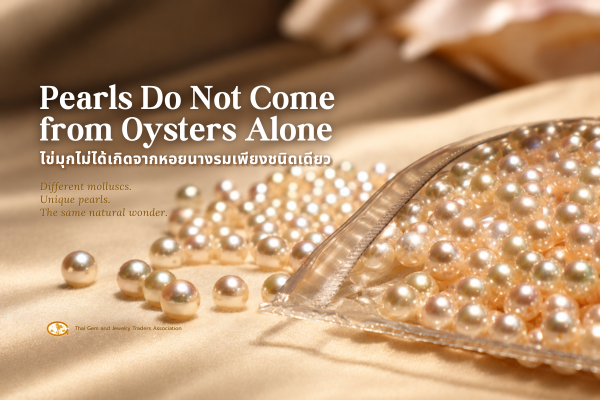
Discover six groups of molluscs that can produce pearls, from pearl oysters and freshwater mussels to Queen Conch, Melo and abalone. Explore pearl structures, gemmological properties, Mother-of-Pearl and quality assessment.

Learn how to estimate gold value using purity, weight and daily buying prices. Explore simple formulas and examples to help you assess your gold before selling.
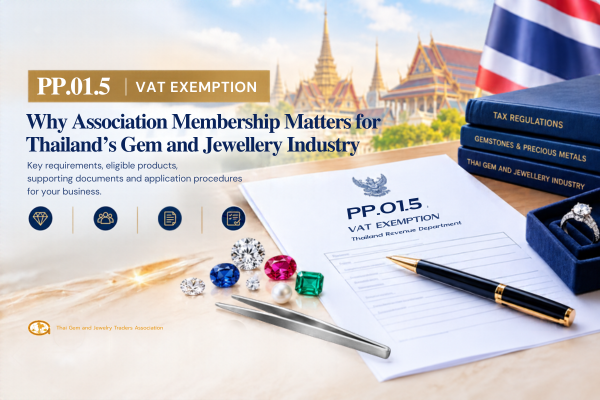
Learn about Thailand’s PP.01.5 VAT exemption, eligible gemstones and precious metals, association membership requirements, supporting documents, and application procedures for gem and jewellery businesses.