
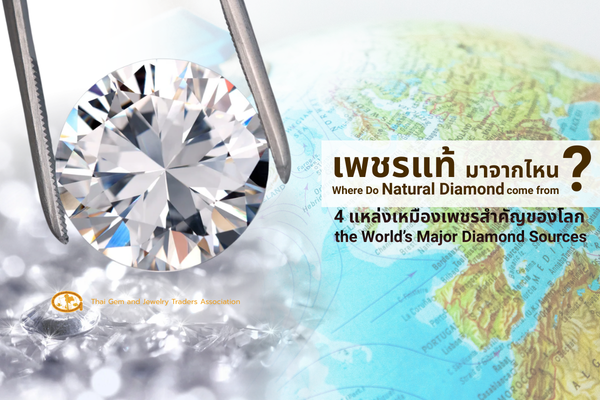
When stepping into a diamond store, one of the most common questions people often hear is about the diamond’s origin. Many are told that the diamond is a “Belgian diamond.” However, the truth is that Belgium has no diamond mines and has never had any in the past.
The term “Belgian Diamond” or “Belgian Cut” originated during a time when Belgium was the world’s largest diamond trading hub. As a result, the country’s name became associated with the image of high-quality diamonds. However, to understand diamonds correctly today, it is important to consider the following facts:
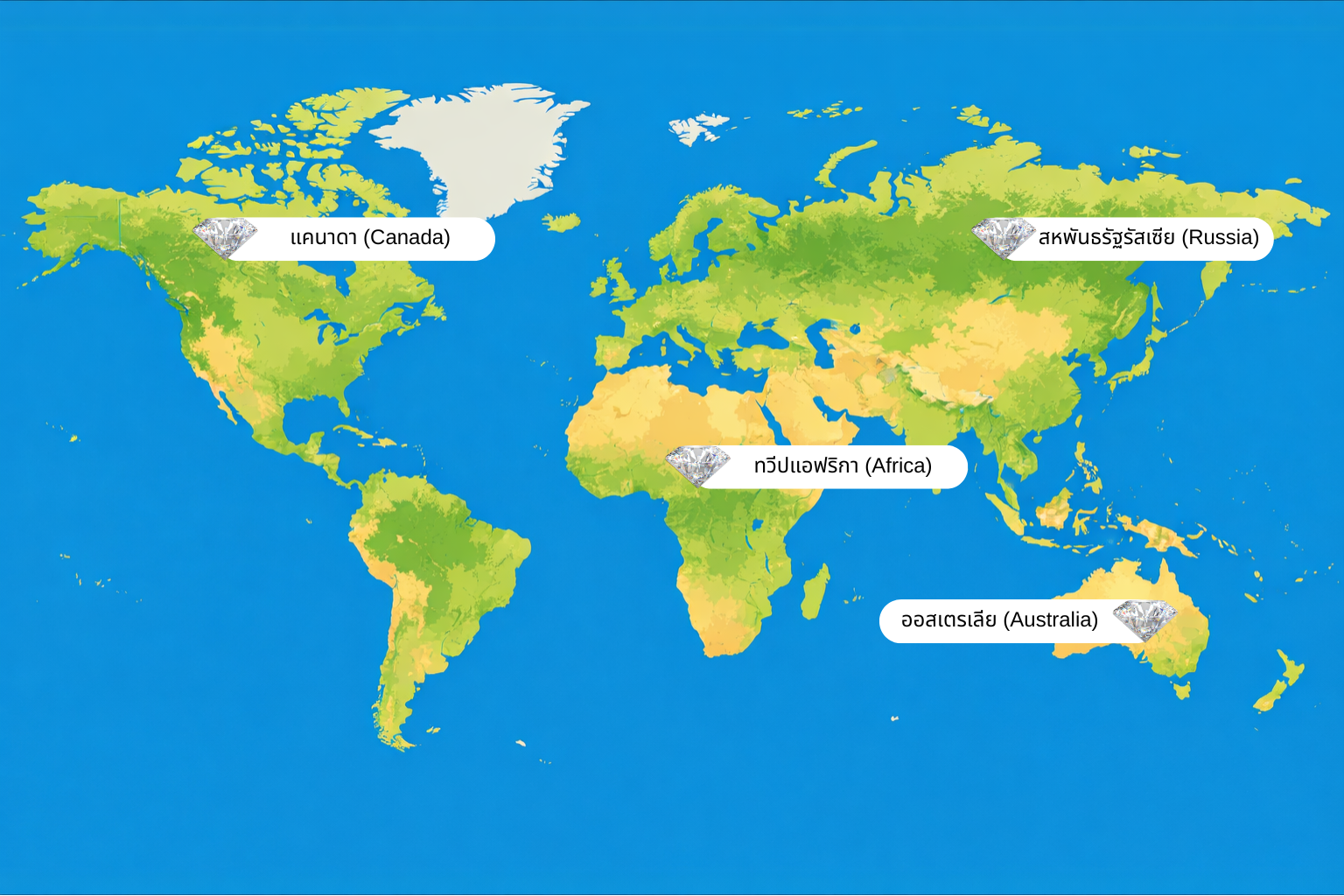
Origin vs. Trading Hub: Belgium is a major diamond trading center, not a mining source. Today, the world’s main diamond mines are located in Africa, Russia, Canada, and Australia.
Cutting Centers: More than 90% of the world’s diamonds are cut and polished in India, which has become the global hub for diamond-cutting skills and advanced technology.
Therefore, using a country’s name to represent diamond quality no longer accurately reflects modern standards. Instead, the gemstone industry now focuses on Cut Quality, which can be objectively measured and certified by international gemological institutions.
In reality, a diamond is the hardest natural crystal on Earth, formed from carbon that crystallizes slowly more than 150 kilometers beneath the Earth’s surface over millions of years. In the past, diamonds were extremely rare and reserved only for royalty or the elite. Today, however, advances in industrial technology have made diamond mining more accessible, allowing more diamonds to be discovered.
So where do the diamonds we wear today come from?
Currently, the world’s largest diamond production comes from four major regions, as follows:
Did you know that around 25% of the world’s diamonds come from Russia? The country hosts some of the largest diamond mines in the world, including the Aikhal mine, operated by ALROSA, Russia’s leading diamond mining company.
Diamonds are so important to Russia that the government stores diamonds as part of its national reserves, similar to gold.
Important note for Thai consumers:
Many people mistakenly use the term “Russian diamond” to refer to fake diamonds. This misunderstanding stems from historical naming conventions (similar to how “Tokyo dessert” is not actually from Japan). In reality, Russia is one of the most important sources of high-quality natural diamonds in the world.
Africa is a continent rich in natural resources, with diamond mining in as many as 16 countries. Four key producers play particularly important roles:
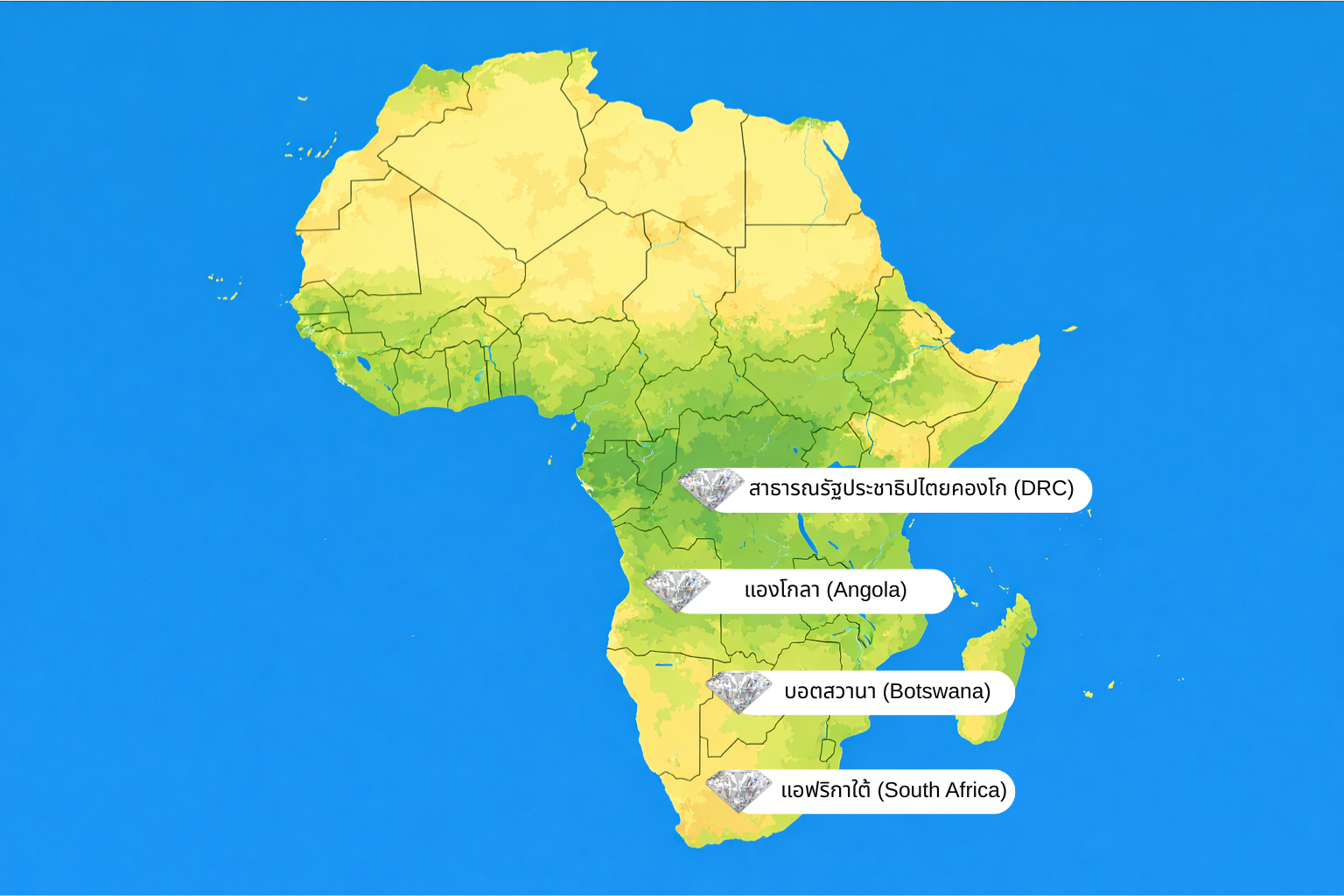
South Africa: One of the most widely recognized diamond sources, partly due to the influence of the film Blood Diamond. South Africa is also the origin of the famous Cullinan Diamond, the largest gem-quality rough diamond ever discovered, weighing 3,106.75 carats when found in 1905. Today, South Africa produces about 7.4 million carats per year, with the Venetia Mine, operated by De Beers, as a major source.
Botswana: Home to the Jwaneng Mine, one of the richest diamond mines in the world, producing more than 25 million carats and frequently yielding large, high-quality diamonds.
Democratic Republic of the Congo (DRC): The fourth-largest diamond producer globally, with annual production reaching approximately 9.9 million carats.
Angola: In 2022, Angola made global headlines with the discovery of “The Lulo Rose,” a 170-carat pink diamond, the largest pink diamond discovered in 300 years.
Diamonds were first discovered in northern Canada in 1991, and commercial mining began in 1998. Although Canada entered the industry later than many other countries, advanced technology allowed it to quickly become one of the world’s top three diamond producers.
Major Canadian mines include Ekati, Diavik, Snap Lake, and Victor, which together produce around 12 million carats of diamonds. Canadian diamonds are also well known for their excellent quality and beauty.
Australia stands out for producing colored diamonds, particularly the extremely rare Pink Diamonds.
Natural pink diamonds are exceptionally rare, with only about 0.01% discovered each year. More than 90% of the world’s pink diamonds historically came from Australia’s Argyle Mine.
Although the Argyle Mine has now closed, Australia still operates other diamond mines such as Merlin, which continues to produce diamonds today.
After reading this far, many people may wonder: Which country produces the best diamonds?
According to experts, no single mine is better than another.
The reality is that every diamond mine produces diamonds of mixed quality, ranging from the finest gem-quality stones to diamonds that do not meet gem standards. Lower-grade diamonds are often classified as industrial diamonds, which are ground into diamond powder and used in tools designed for cutting extremely hard materials like steel.
Therefore, a diamond’s quality and value do not depend on which country or mine it comes from. Instead, its value is determined by the diamond’s unique characteristics—such as color, clarity, and how well it has been cut.

Explore Oval, Marquise, Pear and Cushion gemstone shapes, how to select them for contemporary jewellery design, and how proportions, cutting quality, rarity and market demand influence value.
Explore GEMPORTS Q3 2026 market insights on rubies and sapphires, as GTI rises on premium gemstone transactions amid stable prices and constrained supply.

Learn how to choose a diamond with this guide to the 4Cs: Cut, Colour, Clarity and Carat Weight. Understand natural and laboratory-grown diamonds, grading reports and how to make an informed purchase.