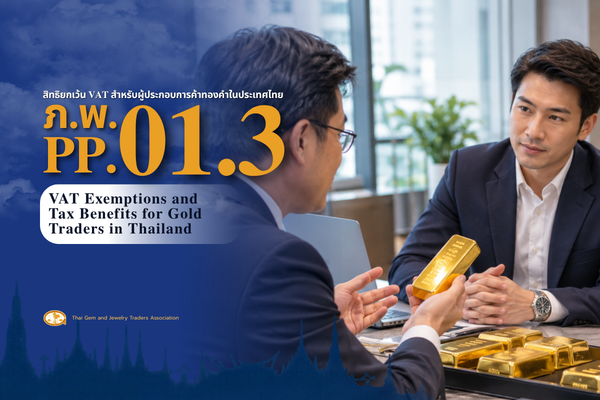
Understanding VAT exemptions on gold and precious metals, eligibility requirements, supporting documents, and the benefits of membership in the Thai Gem and Jewelry Traders Association (TGJTA).
Value Added Tax (VAT) is an important consideration for businesses operating in Thailand's gem and jewellery industry, particularly those involved in importing, trading and manufacturing jewellery using gold and other precious metals.
Thailand has introduced specific tax measures to support the gem and jewellery industry, providing VAT exemptions for certain categories of raw materials, subject to the conditions and requirements prescribed by law.
One of the relevant documents is Form PP.01.3 (Notification of Gold Trading Business), which is used by VAT-registered operators who intend to apply for VAT exemption on the importation or sale of gold that has not yet been manufactured into gold ornaments or other finished articles.
In addition, businesses that are members of the Thai Gem and Jewelry Traders Association (TGJTA) can use their membership certificates as supporting documents when applying for relevant tax privileges under the Revenue Department's regulations.
PP.01.3 is a form issued by the Thai Revenue Department for notifying the authority of a gold trading business. It is intended for VAT-registered operators seeking VAT exemption on the importation or sale of gold that has not yet been manufactured into gold ornaments or other finished articles.
This exemption is based on the Royal Decree Issued under the Revenue Code Governing VAT Exemption (No. 311), B.E. 2540 (1997), as amended by Royal Decree No. 367, B.E. 2543 (2000).
The amendment introduced Section 3 bis, providing VAT exemption for the importation or sale of gold, platinum, white gold, silver and palladium that have not yet been manufactured into jewellery or other finished articles, subject to the criteria, procedures and conditions prescribed by the Director-General of the Revenue Department.
However, PP.01.3 specifically applies to gold trading businesses. It is not a general notification form covering all types of gemstones and precious metals, as different product categories are subject to different notification forms and requirements.
Under Royal Decree No. 311, B.E. 2540 (1997), as amended by Royal Decree No. 367, B.E. 2543 (2000), the importation or sale of certain products may qualify for VAT exemption, provided that they have not yet been manufactured into jewellery or other finished articles, in accordance with the applicable legal requirements.
The relevant product categories include:
Gold: Such as gold bars that have not been manufactured into gold jewellery.
Platinum: Precious metal used in jewellery manufacturing.
White Gold: A gold alloy used in jewellery production.
Silver: Precious metal commonly used in jewellery and decorative products.
Palladium: Precious metal used in jewellery manufacturing and other applications.
Gemstones: Certain gemstones may also qualify for VAT exemption, subject to the specific types and conditions prescribed under the relevant Royal Decrees and notifications issued by the Revenue Department.
For gold qualifying under the PP.01.3 requirements, the gold content must be at least 96.50 per cent by weight.
Other precious metals and gemstones must meet their respective product-specific requirements and conditions.
It is important to note that VAT exemption does not automatically apply to every product within these categories. Businesses must satisfy the relevant eligibility requirements and comply with the procedures prescribed by the Revenue Department.
One of the important benefits of membership in the Thai Gem and Jewelry Traders Association (TGJTA) is access to an official membership certificate, which can be used as supporting documentation when applying for relevant VAT exemptions under the Revenue Department's regulations.
For businesses involved in importing or trading gold and precious metals, evidence of membership in a relevant trade association is one of the requirements under certain VAT exemption provisions.
Relevant tax benefits include:
VAT exemption on the importation or sale of gold that has not yet been manufactured into gold ornaments or other finished articles, provided that the gold content is at least 96.50 per cent by weight and all PP.01.3 requirements are met.
VAT exemption on the importation or sale of platinum, white gold, silver and palladium that have not yet been manufactured into jewellery or other finished articles, subject to the applicable regulations.
VAT exemption on the importation or sale of certain gemstones that have not yet been set into jewellery or other finished articles, for use in jewellery manufacturing or other qualifying products, subject to the conditions prescribed by law.
These tax measures are intended to support business operators, reduce tax burdens associated with sourcing raw materials and strengthen the competitiveness of Thailand's gem and jewellery industry.
Important: TGJTA membership does not automatically grant VAT exemption. Businesses must also be VAT-registered, meet the applicable eligibility criteria, submit the relevant notification forms and comply with all requirements concerning the products and transactions involved.
Businesses in the gem and jewellery industry should understand that the Revenue Department provides different notification forms according to the types of products involved.
Two important forms are PP.01.3 and PP.01.5.
PP.01.3 – Notification of Gold Trading Business
This form applies to gold trading businesses involving gold that has not yet been manufactured into gold ornaments or other finished articles. A key requirement is that the gold content must be at least 96.50 per cent by weight.
PP.01.5 – Notification of Business Involving the Importation or Sale of Gemstones and Precious Metals
This form applies to businesses importing or selling gemstones, platinum, white gold, silver and palladium, as specified in the form and subject to the relevant eligibility requirements.
Both forms involve supporting documentation and association membership requirements where prescribed by the applicable regulations.
Businesses should therefore select the appropriate form according to the products and nature of their operations. PP.01.3 should not be understood as covering all types of gemstones and precious metals.
The relevant forms can be obtained directly from the Thai Revenue Department:
Businesses intending to claim VAT exemption on the importation or sale of gold must comply with the requirements prescribed by the Revenue Department.
The key conditions include:
1. VAT Registration
The business operator must be registered for VAT and comply with the relevant tax calculation and reporting requirements under Section 82/3 of the Revenue Code.
2. Eligible Gold Products
The gold must not yet have been manufactured into gold ornaments or other finished articles. Its gold content must be at least 96.50 per cent by weight.
3. Notification of Gold Trading Business
The business operator must submit Form PP.01.3 to the Revenue Department to notify the authority of its gold trading activities in accordance with the prescribed requirements.
4. Supporting Documentation for Importation or Sale
For imports, the importer must provide the relevant import documentation to Customs officials when submitting the import declaration for customs clearance, together with documentation from the overseas seller confirming that the importer is the purchaser of the gold.
For domestic sales, the business operator must provide evidence of membership in an association related to gold or gemstone trading, as required under the applicable regulations.
5. Gold Trading Records
Business operators must maintain gold trading records in the prescribed format and retain supporting documents at their business premises for inspection by the Revenue Department.
Compliance with these conditions is essential to ensure that VAT exemption is claimed correctly and in accordance with Thai tax regulations.
To facilitate the notification process, business operators should prepare the required supporting documents in advance.
The documents specified by the Revenue Department may include:
A copy of the identification card of the business owner, managing partner or authorised director of the company.
A copy of the taxpayer identification document, where applicable.
A copy of the commercial registration certificate for an individual business operator, or a copy of the company's registration certificate.
A copy of the second-hand goods trading licence, if applicable.
A copy of the membership certificate issued by a relevant association for gold or gemstone traders.
A copy of VAT Registration Certificate (PP.20), or Form PP.01 where the PP.20 certificate has not yet been issued.
A copy of the Revenue Department's approval for consolidated VAT filing (PP.30), where applicable.
The exact documentation may vary depending on the legal status of the business and its registration details. Applicants should therefore check the latest official requirements before submitting their applications.
Further details are available from the Revenue Department:
Revenue Department – PP.01.3 Application and Supporting Documents
Business operators can notify the Revenue Department of their gold trading activities through the following channels.
In-person submission: Submit the application to the relevant Area Revenue Office in accordance with the prescribed jurisdiction and filing requirements.
Electronic submission: Submit the notification through the Revenue Department's designated electronic filing system, subject to the available services and applicable requirements.
Businesses operating multiple premises must notify the Revenue Department separately for each relevant business location, even if they have been granted approval to file consolidated VAT returns.
Important update: The Revenue Department has introduced electronic submission for PP.01.3 from 1 October 2025, providing an additional channel for business operators to complete the notification process.
In addition to VAT exemptions for gold that has not yet been manufactured into jewellery, business operators and consumers should understand the specific VAT calculation rules applicable to finished gold jewellery.
Under Notification of the Director-General of the Revenue Department on VAT (No. 40), eligible VAT-registered gold jewellery traders holding a second-hand goods trading licence under the relevant legislation may exclude an amount equivalent to the published gold jewellery buy-back price from the VAT tax base, subject to the prescribed conditions.
Under this arrangement, VAT on qualifying domestic sales of gold jewellery is calculated on the difference between the selling price and the gold jewellery buy-back price announced by the Gold Traders Association on the date of sale.
The selling price includes the making charge but excludes VAT.
This treatment applies to qualifying finished gold jewellery, including jewellery worn on the body, ornaments, gifts and display items, provided that the products meet the applicable legal definition and do not contain gemstones. The business operator must also satisfy the relevant eligibility requirements.
However, the VAT treatment of imported finished gold jewellery must be distinguished from that of domestic sales.
Imported finished gold jewellery does not qualify for the VAT exemption applicable to gold that has not yet been manufactured into jewellery, even if its gold content is at least 96.50 per cent.
In Revenue Department ruling No. Kor Kor 0702/634, dated 5 February 2026, the Department clarified that VAT on imported finished gold jewellery must be calculated on the full import value, rather than on the making charge alone.
Thailand's gem and jewellery industry involves a complex supply chain, ranging from the importation of diamonds, coloured gemstones and precious metals to raw material trading, jewellery manufacturing and international exports.
VAT exemption measures for qualifying raw materials play an important role in supporting this supply chain. By reducing tax burdens at the raw material sourcing stage, these measures can help businesses manage operating costs and strengthen the competitiveness of Thai manufacturers and traders in international markets.
For TGJTA members, an official membership certificate can serve as supporting documentation when applying for relevant tax privileges under the Revenue Department's regulations, including those associated with PP.01.3 and PP.01.5, depending on the product category and applicable requirements.
Business operators should therefore familiarise themselves with the relevant eligibility criteria, prepare the necessary documentation and maintain proper accounting and trading records to ensure compliance with Thai tax regulations.
Membership in the Thai Gem and Jewelry Traders Association (TGJTA) offers more than access to a professional business network. It also provides members with opportunities to access industry-related information, support services and relevant business privileges.
One important benefit is the ability to use an official association membership certificate as supporting documentation when applying for VAT exemptions on the importation or sale of qualifying gemstones and precious metals, in accordance with the Revenue Department's regulations.
Understanding the differences between PP.01.3 and PP.01.5 is therefore important for businesses involved in importing, trading and manufacturing jewellery. Selecting the correct notification form and complying with the relevant conditions can help businesses manage their tax obligations and operate more efficiently.
The Thai Gem and Jewelry Traders Association (TGJTA) remains committed to supporting Thailand's gem and jewellery businesses through professional networking, industry information, business development and access to relevant industry privileges, contributing to the long-term strength and international competitiveness of Thailand's gem and jewellery industry.
The following official sources provide further information on Thailand's VAT exemption framework and related requirements.
Royal Decree Issued under the Revenue Code Governing VAT Exemption (No. 311), B.E. 2540 (1997)
Royal Decree Issued under the Revenue Code Governing VAT Exemption (No. 367), B.E. 2543 (2000)
Revenue Department – Notification on VAT Exemption for Gold Trading
Revenue Department – Form PP.01.3: Notification of Gold Trading Business
Revenue Department – VAT Notification Forms PP.01.3 and PP.01.5
Revenue Department – Notification Concerning Gemstones and Precious Metals
Revenue Department – Notification of the Director-General on VAT (No. 40)
Revenue Department Ruling No. Kor Kor 0702/634, dated 5 February 2026
Disclaimer: This article is intended for general educational purposes and does not constitute legal or tax advice. Eligibility for VAT exemption depends on the business operator's registration status, the nature of the products and transactions, and compliance with the applicable requirements of the Revenue Department. Business operators should consult the Revenue Department or a qualified tax professional before claiming any exemption.
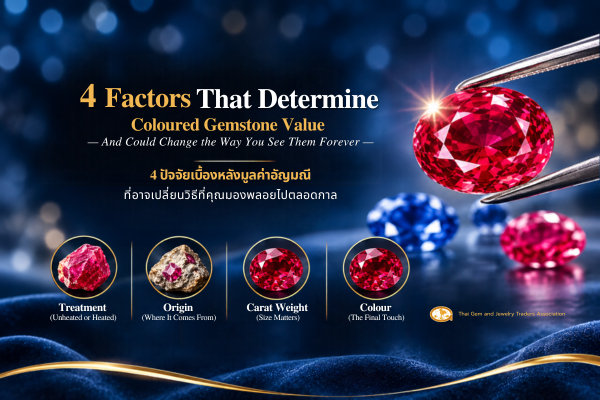
Discover the 4 key factors influencing ruby and sapphire values: treatment, origin, carat weight and colour, with Q3 2026 Gemports reference prices.

รู้จักองค์กรสำคัญในอุตสาหกรรมเพชรโลก ตั้งแต่ Kimberley Process, CIBJO, WFDB, WDC, GIA ไปจนถึงสมาคมการค้าและหน่วยงานกำกับดูแล ที่มีบทบาทต่อมาตรฐาน ความโปร่งใส และความเชื่อมั่นในตลาดเพชร

Discover six groups of molluscs that can produce pearls, from pearl oysters and freshwater mussels to Queen Conch, Melo and abalone. Explore pearl structures, gemmological properties, Mother-of-Pearl and quality assessment.